Quick facts:
- Australia is home to over 40 species of funnel-web spiders
- There have been 13 documented deaths from funnel-web spider bites
- Over 100 people have been saved from antivenom
- 30-40 people are bitten by funnel-web spiders yearly in Australia
For immediate first aid treatment for funnel-web spider bites, follow these steps:
- Stay calm
- Call 000
- Apply a pressure bandage
- Splint the limb
- Be ready to perform CPR
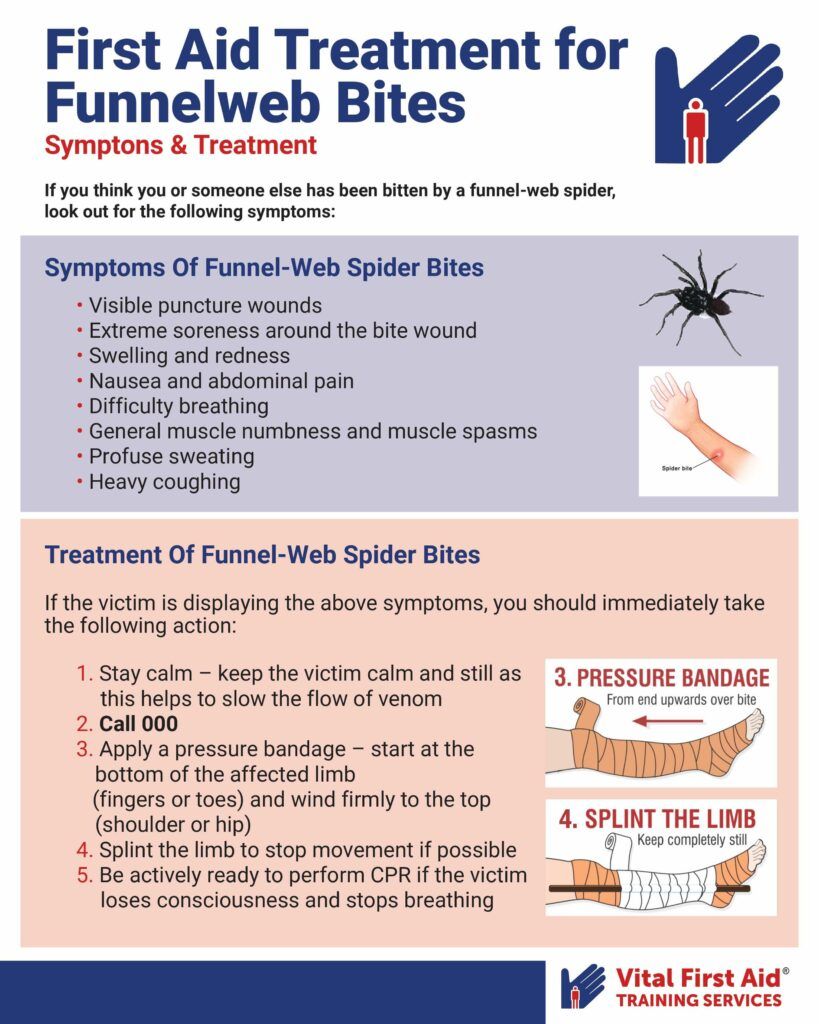
For a more depth explanation of first aid treatment, and a helpful infographic, click here.
Atracids, more commonly known as funnel-webs, are a notorious family of spiders that are native to Australia. The not-so-itsy-bitsy funnel-web spider is one of the most venomous spiders in the world, and is responsible for 13 fatalities.
Luckily, in 1981 an antivenom was developed. Since then, there have been no recorded deaths and over 100 people have been saved by the antivenom.
But 30-40 people are bitten by funnel-web spiders every year in Australia. And when not treated correctly there can be fatal or very serious consequences.
Furthermore, funnel-web spiders thrive in humid conditions, as it’s their preferred weather for mating (9 News). This means the Australian summer, which spikes to an average humidity of 65%, offers the perfect conditions for funnel-web spiders.
That’s why it’s important to be prepared for the unfortunate situation of a funnel-web spider bite, and better yet, know how to avoid the situation altogether.
In this guide, we’ll look at the dangers of funnel-web spiders, and how to avoid, identify symptoms of, and treat a funnel-web spider bite.
Navigate:
- What Makes Funnel-Web Spiders So Dangerous?
- How To Avoid A Funnel-Web Spider Bite
- Symptoms Of Funnel-Web Spider Bites
- Treatment Of Funnel-Web Spider Bites
- FAQ
- Learn First Aid
What Makes Funnel-Web Spiders So Dangerous?
Australia is home to over 40 species of funnel-web spiders (Australian Museum). However, not all species are known to be dangerous. The deadliest species is the male of Atrax robustus, more commonly known as the Sydney funnel-web spider, which is responsible for all recorded deaths and many more bites which have led to serious medical emergencies.
What makes the Sydney funnel-web spider particularly so fatal are delta-hexatoxins, which are the neurotoxic peptides found in the venom (The University of Queensland). The Sydney funnel-web spiders’ toxins originally evolved to prey on insects such as cockroaches and flies. But as the male spiders left the safety of their burrow they started to encounter dangerous vertebrate predators, such as birds and bandicoots. This natural selection put pressure on the venom of the male spider to switch from insect-specific to vertebrate-specific.
And unfortunately, we humans are vertebrate species. And this venom can kill a human in just 15 minutes (Australian Geographic).
How To Avoid A Funnel-Web Spider Bite
To avoid a bite from a funnel-web spider it’s crucial to know what they look like and where you’ll likely find them.
How to identify a funnel-web spider:
- Black body and legs
- Shiny carapace (front part of their body)
- Medium to large size (1cm to 5cm)
If a spider fits the above criteria, it is best to avoid it carefully.
Even if it’s not a funnel-web spider, it could still be another dangerous ‘big black spider’, such as the mouse spider, which is venomous and very common in Australian households.
So where do funnel-web spiders live?
Funnel-web spiders are typically found in the moist forest regions of Australia’s east coast, ranging from Tasmania to North Queensland.
As they like to make their burrows in moist sheltered habitats, you likely won’t find them in the middle of your backyard lawn, but rather under loose rocks, bark, or logs while gardening.
Now you know what to look out for, here’s how you can significantly reduce your chances of being bitten by a funnel-web spider:
- Keep your garden free of rubble and rubbish where spiders can hide
- Wear fully-enclosed shoes with socks, gloves and a long sleeved shirt when gardening
- Proactively check your shoes and household items for funnel-web spiders
Symptoms Of Funnel-Web Spider Bites
If you think you or someone else has been bitten by a funnel-web spider, look out for the following symptoms:
- Visible puncture wounds
- Extreme soreness around the bite wound
- Swelling and redness
- Nausea and abdominal pain
- Difficulty breathing
- General muscle numbness and muscle spasms
- Profuse sweating
- Heavy coughing
Treatment Of Funnel-Web Spider Bites
If the victim is displaying the above symptoms, you should immediately take the following action:
- Stay calm – keep the victim calm and still as this helps to slow the flow of venom
- Call 000
- Apply a pressure bandage – start at the bottom of the affected limb (fingers or toes) and wind firmly to the top (shoulder or hip)
- Splint the limb to stop movement if possible
- Be actively ready to perform CPR if the victim loses consciousness and stops breathing
Funnel-Web Spider Bite: Frequently Asked Questions (FAQ)
1. What is a funnel-web spider?
The funnel-web spider refers to a group of highly venomous spiders native to Australia, particularly in New South Wales. The Sydney funnel-web (Atrax robustus) is the most notorious, known for its aggressive behavior and potentially lethal bite.
2. How dangerous is a funnel-web spider bite?
Funnel-web bites can be extremely dangerous, especially from male Sydney funnel-webs. Their venom affects the nervous system and can cause severe symptoms or even death if not treated promptly. However, due to the availability of effective antivenom, fatalities are now extremely rare.
3. What are the symptoms of a funnel-web spider bite?
Initial symptoms may include:
- Intense pain at the bite site
- Tingling around the mouth
- Sweating
- Nausea and vomiting
- Increased heart rate
- Breathing difficulties
In severe cases, symptoms can escalate rapidly, requiring urgent medical intervention.
4. What should I do if bitten by a funnel-web spider?
Immediate first aid is critical:
- Call emergency services (000 in Australia)
- Apply a pressure immobilisation bandage (P.I.B.) around the bite and affected limb
- Keep the person calm and still
- Do not cut the wound or apply a tourniquet
- Transport to a hospital as quickly as possible
5. How can I identify a funnel-web spider?
Funnel-webs are medium to large (1.5–5 cm), black or dark brown, and glossy. They have large fangs and a distinctive, barrel-shaped abdomen. Males are more slender and mobile, often seen during warm, humid months searching for mates.
6. How quickly do symptoms appear after a bite?
Symptoms can begin within 15 minutes of the bite, but sometimes take up to an hour. Children may develop symptoms more quickly due to their smaller body size.
7. Is there an antivenom for funnel-web bites?
Yes. Antivenom for funnel-web spider bites has been available since 1981 and has proven highly effective. No deaths have occurred in Australia from funnel-web bites since its introduction.
8. Can a funnel-web spider bite through clothing or shoes?
Yes. Their fangs are strong enough to pierce soft shoes, gloves, or thick socks. Wearing heavy boots and tucking pants into socks can help prevent bites when working in high-risk areas.
9. Where are funnel-web spiders most commonly found?
They are found in moist, cool environments such as under rocks, logs, or in garden mulch. In suburban areas, they may enter homes, especially during mating season (typically summer and autumn).
10. How can I prevent funnel-web spider bites at home?
- Seal cracks and crevices around the house
- Wear gloves when gardening
- Shake out shoes and clothing before use
- Keep outdoor shoes and toys indoors when not in use
- Be cautious when handling firewood or landscaping materials
Learn First Aid & CPR This Summer With Vital First Aid
Not only can learning first aid and CPR be crucial in dealing with a funnel-web spider bite, but it can save lives in a variety of situations.
Our first aid courses and CPR courses are run throughout the summer by our professional and friendly team.
We hold courses throughout Sydney, Newcastle and the Central Coast.
If you’re interested, call us today, or book a course online.