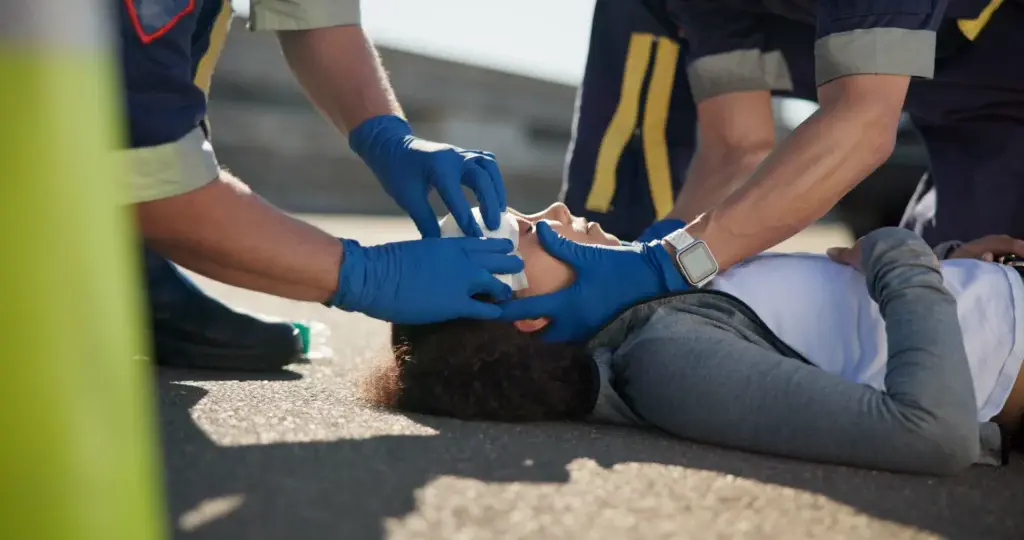
Head injuries in the workplace range from minor knocks to serious, life-threatening trauma.
They can occur in offices, warehouses, construction sites, and customer-facing environments, often when people least expect them.
Knowing how to respond correctly is not just a safety issue; it is a responsibility.
This guide explains what effective first aid for head injury workplace situations looks like, how to recognise danger signs, and how trained responders can reduce the risk of long-term harm.
What is a workplace head injury?
A head injury is any trauma to the scalp, skull, or brain caused by impact, penetration, or sudden force.
In workplace settings, these injuries most commonly result from:
- Slips and falls
Wet floors, uneven surfaces, and poor lighting are frequent contributors. - Falling or moving objects
Tools, stock, or unsecured equipment can strike the head unexpectedly. - Vehicle and machinery incidents
Forklifts, site vehicles, and plant equipment significantly increase risk. - Assaults or collisions
More common in healthcare, retail, and customer-facing roles.
Some injuries appear mild at first but can worsen over time.
This is why early and accurate first aid matters.
Why is first aid for head injury in workplace incidents critical
The brain is vulnerable to swelling and bleeding after trauma.
Even a short delay in treatment can lead to serious complications.
Effective workplace first aid helps to:
- Reduce the risk of secondary brain injury
- Prevent further movement that could worsen spinal damage
- Identify red flags early so medical care is not delayed
- Support compliance with workplace health and safety obligations
Many organisations address this risk by ensuring staff complete accredited training through providers such as Vital First Aid, whose corporate first aid training programs are designed specifically for real workplace emergencies.
How to recognise a head injury at work
Recognition is often the most important step.
Symptoms may appear immediately or develop gradually over several hours.
Common symptoms
These signs require close monitoring:
- Headache or pressure
- Dizziness or balance problems
- Confusion or difficulty concentrating
- Nausea
- Fatigue or drowsiness
Serious warning signs
These indicate a medical emergency:
- Loss of consciousness, even briefly
- Repeated vomiting
- Worsening headache
- Slurred speech or unusual behaviour
- Seizures
- Unequal pupil size
- Fluid or blood from the nose or ears
If any of these symptoms are present, emergency services must be contacted immediately.
Immediate first aid for head injury in workplace situations
The goal of first aid is to stabilise the injured person and prevent further harm until professional help takes over.
Step-by-step response
- Make the scene safe
Remove hazards and ensure you are not putting yourself at risk. - Keep the person still
Encourage them to remain calm and avoid movement, particularly of the neck. - Check consciousness and breathing
If unconscious or not breathing normally, call emergency services immediately. - Control bleeding carefully
Apply gentle pressure with a clean dressing unless a skull fracture is suspected. - Monitor continuously
Watch for changes in consciousness, behaviour, or breathing.
Skills such as these are covered in essential courses like HLTAID011 Provide Basic Emergency Life Support, which focuses on managing unconscious casualties and maintaining vital signs
Managing suspected spinal involvement
Many head injuries occur alongside neck or spinal trauma.
Moving the casualty incorrectly can cause permanent damage.
If a spinal injury is suspected:
- Do not move the person unless absolutely necessary
- Support the head and neck in a neutral position
- Prevent unnecessary movement while awaiting help
Training such as PUAEME007 Provide Emergency Care for Suspected Spinal Injury equips first aiders with the skills to manage these high-risk situations safely and confidently.
When to call emergency services
Workplace first aid does not replace medical treatment.
Knowing when to escalate is critical.
Call emergency services if the injured person:
- Loses consciousness at any point — replace with ‘any loss in conscious level”
- Shows worsening symptoms
- Has severe bleeding or a visible head deformity
- Experiences seizures
- Cannot be kept awake or alert
If in doubt, always err on the side of caution.
Early intervention saves lives.
Why advanced training improves workplace outcomes
Basic first aid knowledge is valuable, but higher-risk workplaces benefit from advanced capability.
Courses such as HLTAID014 Provide Advanced First Aid prepare designated first aiders to manage complex injuries, coordinate responses, and support casualties for extended periods.
Advanced training improves:
- Confidence during high-pressure incidents
- Accuracy in recognising serious injuries
- Decision-making when multiple hazards are present
- Overall workplace safety culture
This is particularly important in environments where emergency response times may be longer.
Preventing head injuries in the workplace
Prevention remains the most effective control measure.
Employers should focus on reducing risks before incidents occur.
Practical prevention strategies
- Risk assessments
Identify high-risk tasks, areas, and equipment. - Environmental controls
Improve lighting, signage, and floor maintenance. - Protective equipment
Use helmets or hard hats where appropriate. - Training and awareness
Educate workers on hazards and safe behaviours. - Clear emergency procedures
Ensure staff know how to respond if an injury occurs.
A proactive approach significantly reduces incident rates and severity.
Why workplaces trust Vital First Aid
Vital First Aid is a Registered Training Organisation with over 25 years of experience delivering realistic, evidence-based first aid training.
Their instructors are experienced emergency service professionals, including paramedics, firefighters, and police officers.
This ensures training reflects real emergencies, not textbook scenarios.
From entry-level life support to advanced workplace response, Vital First Aid helps organisations build competence, confidence, and compliance across their teams.
Conclusion
Are you prepared for a head injury at work?
Head injuries are unpredictable, but your response does not have to be.
Understanding first aid for head injury workplace situations reduces risk, improves outcomes, and protects both workers and businesses.Vital First Aid delivers practical, professional training that prepares teams for real-world emergencies.
If you want to strengthen your workplace safety systems and ensure your staff are ready to respond when it matters most, get in touch with Vital First Aid today.