Quick facts:
- Choking represents 9% of injury deaths and 0.3% of injury hospitalisations.
- The most common cause of death from choking is due to choking on objects.
- Elderly individuals face the highest choking-related mortality, whereas young children have the highest hospitalisation rates for this issue.
- Hospitalisation from choking is highest in elderly people with 33% of individuals 65 and older and 23% of children aged 0-4.
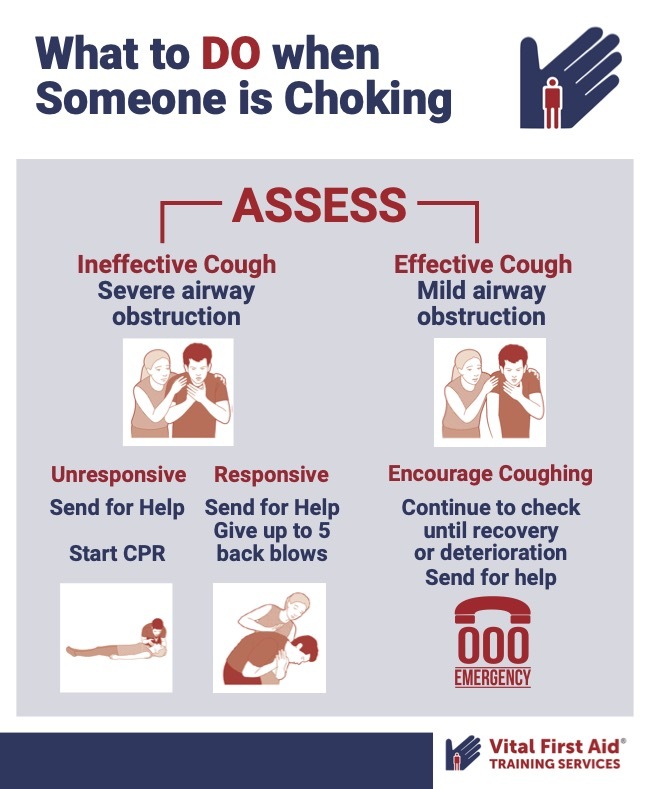
For immediate first aid treatment for choking, follow these steps:
- Check for ineffective cough.
- If unresponsive, call for help.
- In the case of severe airway obstruction, start CPR.
- Give up to 5 back blows.
- Encourage coughing.
- Keep checking for recovery or deterioration.
- If it’s a mild airway obstruction or there’s an effective cough, seek help.
Read on to learn more about Choking, and how to prevent and manage it.
Explore this blog:
- What is Choking?
- Signs of Choking
- Causes of Choking
- First Aid Response for Asphyxiation by Choking
- What Not To Do When Someone Is Choking
- FAQ
- Differences in First Aid for Choking Between Children and Adults
Many of us may have experienced or witnessed choking and know how alarming it can be. Choking occurs when the airway is blocked by an object, food, or fluid. This prevents oxygen from getting to the lungs, and if not addressed quickly can lead to unconsciousness, and in severe cases, brain damage or death.
With how common choking is, it’s important to know the steps of first aid for choking so that you can help in an emergency.
What is Choking?
Choking occurs when an airway becomes partially or wholly blocked by a foreign object – such as food – and breathing becomes difficult.
This airway is called the trachea (also referred to as the windpipe), and sits in front of the oesophagus. Your oesophagus is responsible for transferring food to your stomach.
Naturally, having your windpipe and food pipe so close together sounds counterintuitive, but there are a few key advantages with this layout, primarily relating to better verbal communication functions.
The reason food (or other objects) usually don’t block your airway, is thanks to the epiglottis – an elastic cartilage “flap” that shuts to prevent food from entering the trachea. When this mechanism fails, your windpipe is then exposed to food, and thus choking can result.
Signs of Choking
The familiar sign to alert of choking is clutching the hands to the throat. Of course, this may not always be the case, especially in young children. Common warning signs of choking include:
- Noisy breathing/difficulty breathing
- Panicked behaviour
- Unable to talk
- Skin becomes flushed then turns pale or bluish
- Lips, skin, and nails turn grey or blue
- Squeaky/wheezing sounds while attempting to breathe
- Watery eyes
- Red face
- Losing consciousness
- Coughing – forceful or weak
Causes of Choking
Choking in young children is often as a result of swallowing small objects, be it food or items such as beads or buttons, while for adults, it’s usually from a piece of food. It’s important that children are always supervised when they are eating.
Food is the most prevalent cause of choking, with research from USA and Canada suggesting grapes, sweets, and hotdogs are the most common causes of choking related deaths.
Other common choking hazards include liquids, coins, toys, magnets, buttons, and batteries.
First Aid Response for Asphyxiation by Choking
Choking cuts off oxygen to the brain, and the brain can only survive a few minutes without oxygen, so it’s crucial to give first aid as soon as possible.
Call 000 immediately for an emergency or if the foreign object cannot be easily removed.
Emergency services receive many calls for choking emergencies, and thankfully, first aid provided immediately and correctly can save the life of someone who is choking.
There are varied first aid responses for choking, which may be dependent on:
- If the person is conscious or unconscious
- Whether the person is a child or an adult
- If you are performing first aid on yourself or another person.
Conscious person
- Offer reassurance and encourage them to breathe and cough
- Call 000
- If they do not have an effective cough lean then slightly forward and, with the heel of your hand, deliver back blows between the shoulder blades. After each blow, check if the object has removed itself
Unconscious not-breathing normally person
- Call 000
- Remove any visible obstruction from their mouth
- Commence CPR.
Yourself
- Attempt to stay calm and, if possible, attract someone’s attention for assistance
- Cough forcefully if you can
- Lean forward as far as you can, holding onto something anchored if possible. Breathe out, then take a deep breath in and cough to try and remove the object.
What Not To Do When Someone Is Choking
Some important things to avoid when providing first aid for choking victims are:
- DON’T place your fingers in their mouth
- DON’T pick up a child/infant who is choking and turn them upside down
- DON’T perform mouth-to-mouth
- DON’T slap the person on the back when upright
- DON’T attempt the Heimlich manoeuvre
Differences in First Aid for Choking Between Children and Adults
Choking is most common in the elderly and infants. As noted above, first aid for adults includes the person leaning forward while delivering back blows and chest thrusts. Use less force on a child than you would on an adult.
For children, don’t pat or slap a choking child on the back if they are managing to cough, as this may dislodge the object and cause it to be inhaled deeper into the airway.
In young children, struggling to breathe may not last long and ceasing panicked activity may signal an emergency situation rather than indicate the object has been dislodged. In children, check for other signs that the child is in shock, such as cold and clammy skin, a pale face, and their responses.
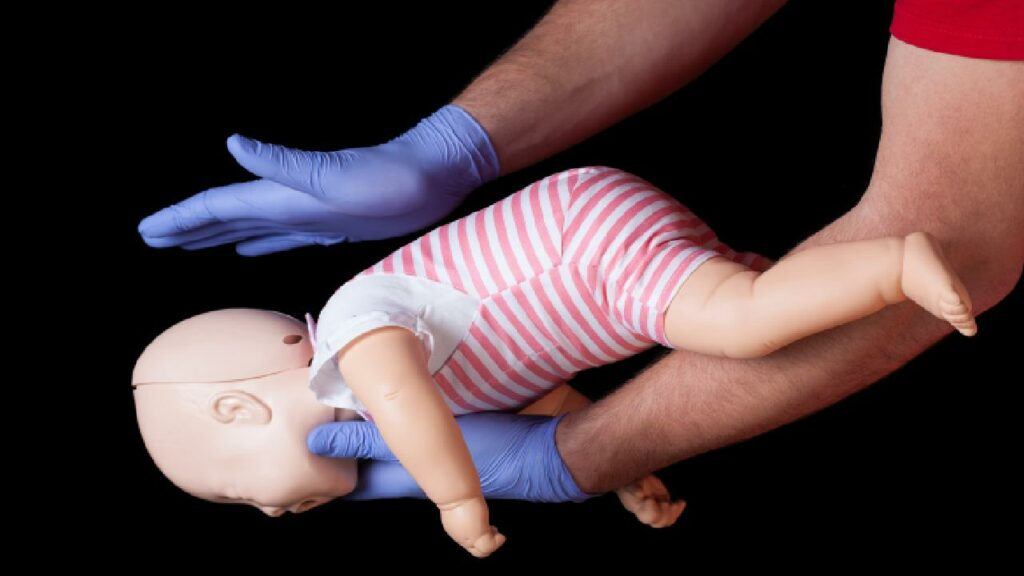
If a baby is choking, place them on your forearm or lap, hold them firmly, their head lower than their body, and use less force than you would on a child.
First Aid for Choking: Frequently Asked Questions (FAQ)
1. What is choking, and how does it happen?
Choking occurs when an object—most commonly food or small items—blocks the airway (trachea), preventing oxygen from reaching the lungs. Normally, the epiglottis prevent this by closing off the airway during swallowing. When this mechanism fails or the object is too large, the airway becomes obstructed, and breathing can stop within minutes.
2. What are the warning signs of choking?
Key signs include:
- Inability to talk or breathe
- Coughing (either weak or forceful)
- Panicked expression or grabbing at the throat
- Squeaky or wheezing sounds while breathing
- Flushed skin turning pale or bluish
- Watery eyes or a red face
- Loss of consciousness if the blockage isn’t cleared
Immediate recognition is crucial, especially if the person cannot speak or cough effectively.
3. What should I do first if someone is choking?
If the person is conscious but cannot cough or breathe effectively, call 000 immediately. If they are able to cough, encourage them to continue. If not, lean them slightly forward and deliver up to five firm back blows between the shoulder blades. After each blow, check if the object is dislodged. If the person becomes unresponsive, start CPR.
4. What’s the difference between mild and severe airway obstruction?
A mild obstruction means the person can still cough or speak—encourage them to continue coughing. A severe obstruction means they are silent or struggling to breathe—this requires immediate first aid (back blows or CPR) and a call to emergency services.
5. How do I help a choking baby?
Place the baby face down along your forearm or lap, with their head lower than their body. Support their head and neck, then deliver gentle but firm back blows using the heel of your hand. Do not use excessive force. If the baby becomes unconscious, begin CPR and call 000 immediately.
6. Can I help myself if I’m choking and alone?
Yes. Try to remain calm and:
- Cough forcefully if able
- Bend forward and brace against a solid surface
- Take a deep breath, exhale, then forcefully cough to dislodge the object
If possible, alert someone nearby or call 000 while trying to clear the blockage.
7. What should I avoid doing when someone is choking?
Do not:
- Stick your fingers in their mouth (unless the object is clearly visible and easily removable)
- Pick up or shake a child upside down
- Perform back slaps while they’re upright
- Perform mouth-to-mouth if they are still conscious
- Attempt the Heimlich manoeuvre unless properly trained, as it’s not routinely recommended in Australia
8. How is choking first aid different for children and adults?
For adults and older children, lean them forward and use firm back blows. For young children, use gentler force. If the child can cough or breathe, avoid any physical intervention, as you may worsen the obstruction. For babies, always keep their head lower than their body and support their neck and jaw.
9. Who is most at risk for choking?
Choking poses the highest risk to infants aged 0–4 and elderly individuals over 65. Infants often choke on small objects or food, while elderly individuals may have difficulty swallowing or managing dentures. People with neurological or muscular conditions may also be more vulnerable.
10. Can I learn to respond to choking emergencies in a First Aid course?
Absolutely. A certified First Aid course, like those offered by Vital First Aid, teaches you how to confidently and safely respond to choking in infants, children, and adults. You’ll learn how to assess severity, apply appropriate techniques, and manage emergencies until professional help arrives. Courses are available across Sydney, Newcastle, and the Central Coast.
Learn First Aid For Choking With Vital First Aid
At Vital First Aid, we believe it’s essential that everyone has the knowledge and skills to confidently apply first aid and respond to a medical emergency until professional medical assistance is available.
Our qualified first aid trainers are highly skilled and experienced, and all students receive a First Aid Certificate on completion. To benefit from our range of first aid courses, view our courses.